Sunday, October 29, 2006

Big Bazaar

I worked the Big Bazaar again! I had so much fun last year, I figured why not do it again?
As before, I worked with Ikeda-san , owner of Le Kimono Galerie, down in Yokohama. We had a lot of fun and we did a crazy amount of business-both of us didn't get any lunch, we zoomed right through the eight hours of the first day!

Ikeda-san, in typical Japanese understatement, said "Business was good." (I looked at the tally sheet. Business was REALLY good).

What sells is never consistent. In the spring, we sold a lot of yukata. Last fall, we sold a lot of obis and haori jackets. This fall, lots more kimono and obi sets were sold, along with a lot of wedding robes, which are fairly pricey. The haori didn't sell well at all.

I had a lot of fun wearing my kimono and telling people about kimono and kitsuke and dressing up a few people.

Pix are on flickr.

Friday, October 20, 2006

Morale

As a way to boost office morale, we went bowling.

Friday, October 13, 2006

Navy Day Ball

Got gussied up and went to the Navy Day Ball. Pictures on Flickr.

Snowing

My Aunt Den called to tell me it was snowing at her house. I don't think she realizes it, but ever since we came to Japan, she's called on the day of the first snow. It makes me happy.

Tuesday, October 10, 2006

Worm Farm

If I asked you to think of a farm, chances are you pictured a big, red barn situated on verdant, rolling pastures, with a proud silo silhouetted against a bright blue sky. There might be cows and chickens, or pigs or rows and rows of corn. You might even picture a farmer looking over it all, ensuring that the daily business runs smoothly.

If you were to ask my family to picture a farm, chances are they would envision my father’s infamous Worm Farm. In the course of a short, hot, summer, my father came up with this particular idea, wrestled with some interesting logistics, suffered several terrible setbacks and eventually gave up worm farming altogether.

My father loved to fish. He wasn’t a particularly gifted angler and this was because he was not particularly patient. He wasn’t particularly wealthy, either. Tackle costs money as does bait. But unlike tackle, bait has to be purchased constantly. Nightcrawlers made the best bait for my father’s type of fishing. For those of you who may not know, Nightcrawlers are big worms. BIG—we are talking huge, honkin’ worms, here. Worms the size of Cheez Doodles. Nightcrawlers were expensive, too. My father was not patient. My father was not rich. So he decided he would grow his own.

I recall my father sitting in the coffee-scented kitchen, gleefully scribbling away on a pad of graph paper.

“Whatchya doon, Daddy?”

“I’m building a worm farm!”

“A wo—a what farm?”

“A worm farm! See?” He held up a schematic of what looked like a large box without a top or bottom. “I’ll build it, then I’ll catch worms, and fill up the farm. Then I won’t have to pay for ‘em at the tackle shop!”

“Um, okay, Daddy.” I beat a hasty retreat, lest I get roped into helping (I would anyway, but hope springs eternal).

A few days later, my father appeared with the physical manifestation of his schematic.

He held a topless and bottomless wooden box. It was meticulously made; my father had even dovetailed the corners. I have to admit, the pine box was beautiful, almost a piece of artisan furniture, but I really didn’t understand the extent of his madness. Not at this early point, anyway.

Dad carried the box outside, placed it in my mother’s garden, filled it with dirt, and spent the next two hours rooting around the garden, looking for worms. He inadvertently uprooted most of Mom’s cucumbers, but eventually he got about a dozen worms, which were carefully placed in his “farm.”

Next, weekend, he decided to go fishing. He went to the worm farm, anticipating a bountiful harvest. No worms. He dumped the box out and flung clods of dirt everywhere. There were no worms. No worms. No worms!

As my father sat in the garden, shell-shocked, my mother appeared.

“Where are the worms?” she asked.

“They escaped!” said my incredulous father.

Mom noticed the worm farm. “What happened to the bottom?”

“What bottom? There wasn’t any bot—“

We went fishing that day, anyway, because Dad paid two bucks for a dozen night crawlers

My father was resilient. Worm Farm Phase II was put into action almost immediately. This time, my father put a fine mesh screen across the bottom. Mom refused to let him go tromping through her garden again, so The Bruce L. Trautman Development Company built Worm Farm Phase II on the compost heap in the back yard.

Dad didn’t feel like digging for worms again, so he “seeded” the farm with two dozen purchased crawlers, and hoped that they would reproduce at some ridiculous logarithmic rate. He even began to daydream about a Nightcrawler Empire, wherein he could corner the market and become the primary supplier to local marinas, tackle shops, roadside bait stands, you name it. His delusions of grandeur did not last long. Less than four days, as a matter of fact.

The mesh bottom of Worm Farm Phase II made the worms stay put. However, the top was exposed—to the rain, the sun, the wind…the crows. Having the mesh in place was a good thing for my dad, but a bad thing for the worms.

Restricted by the walls of the Worm Farm, and unable to escape by deeply burrowing, the worms were easy pickings for the crows. For two days, black-feathered, yellow-beaked death rained down on those poor worms. My father just happened to look outside in the middle of one Corvid sortie and rushed out the door, hollering and flailing his arms and acting crazy, even by our family’s generous standards. He eventually waved the voracious birds off, but it was too late. All two dozen worms, totaling a cost of four dollars, had been slurped up, spaghetti-style, by the local feathered gentry. But however put out he was, my father was not down and out.

In addition to being resilent, my father was stubborn. The crows had been just another minor setback. He picked up his worm farm, tucked it under his arm, and marched back to his shop. A few hours later, he emerged, looking triumphant. The worm farm still had its mesh bottom but it also now had a lovely hinged top made of lattice, which came complete with a little latch and a tiny suitcase lock. This was Worm Farm, Phase III.

Dad found a warm and damp but sheltered spot in the yard and placed the worm farm there. He even pulled some dirt up to the sides of the farm, securely anchoring it in a miniature berm. He stole my mother’s very expensive potting soil and lovingly poured it into Worm Farm Phase III, patting it down and making it all very nice. He then ran down to the tackle shop and in an expensive burst of optimism, purchased six Styrofoam containers (at two bucks a piece) of worms. He unloaded his new stock, latched and locked the lid and promptly forgot about the Worm Farm for a third of the summer.

One Saturday, my family was awakened by shouting. Stentorian arpeggios of profanity raked across the mild morning air. There was only one person we knew of who could cuss like that…we ran out to the back porch and there in the backyard, stood my father, holding up the Worm Farm and shaking it, as if he were trying to make a worm-and-mud martini.

As he shook the wooden box, we could see that the fine mesh bottom – the fine METAL mesh bottom had a large rusty hole in it, courtesy of the damp ground. The worms, being opportunists, hadn’t hesitated. They just beat feet or whatever it is that worms beat. At any rate, they were gone, leaving my father a wooden box without a bottom, plenty of wasted effort, and ultimately, some thirty-odd dollars in the hole. It was onto Worm Farm Phase IV. Or was it?

During this apoplectic outburst, my father had an epiphany: mainly that crows couldn’t get into the fridge at the local baitshop; stryofoam couldn’t be penetrated by worms nor would buying bait at the tackle shop cause him to feel like the butt of some cosmic joke…

…And a man had to retain some shred of dignity. Somehow.

My father never complained about buying worms after that.

I miss you, Dad.

Saturday, September 30, 2006

Miyakin

Miyakin is a bakery/sweet shop here in Misawa. The shop is adorable and has traditional Japanese sweets or Wagashi. They also have European-style baked goods. I love Japanese sweets and Miyakin is one of the prettiest shops I've been in. It's my favorite place to get goodies here in Misawa.

I haven't been very well the last two weeks, and it's been wearing on me, physically and emotionally. After yet another trip to the doctor's, I was so upset I needed something to cheer me up, so I went to Miyakin. You can see what I bought at Flickr.

Thursday, September 21, 2006

Tombo

Lonesomely clings the Dragonfly
to the
underside of the leaf
Ah! The Autumn rain.

September in Japan brings the rice harvest, tsukimi (moon viewing), typhoons and dragonflies (not necessarily in that order).

The rice harvest is self-explanatory, I blogged about tsukimi last year, and have already bitched about the typhoons, so let me write about dragonflies.

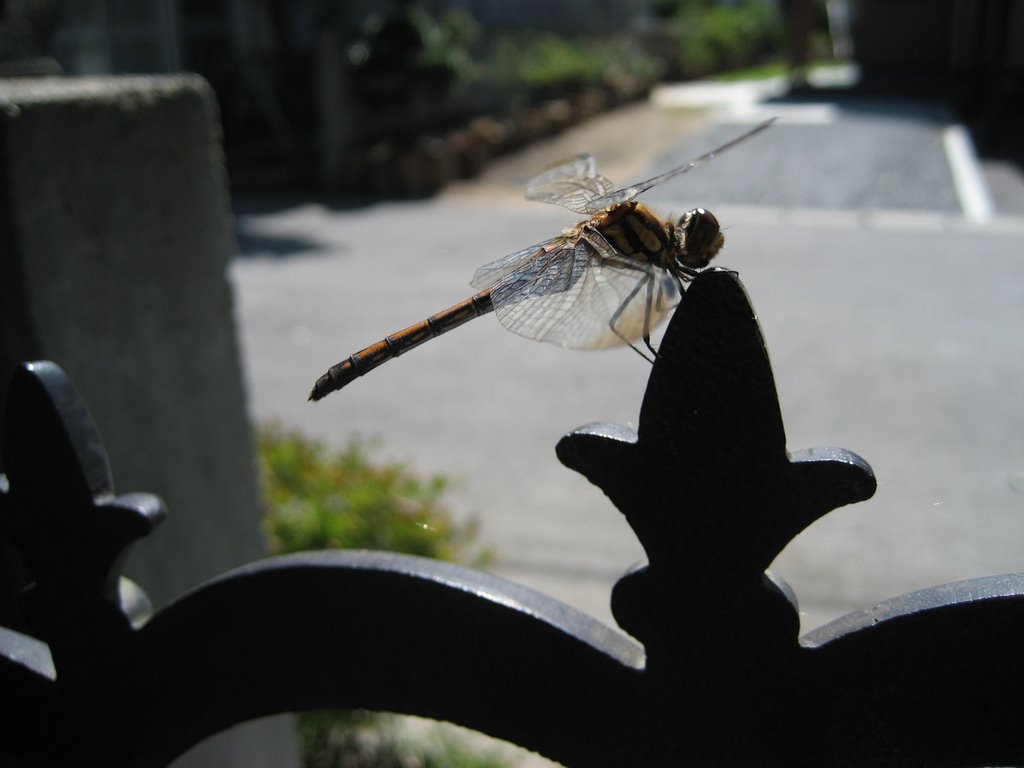
There are dragonflies in Japan. (No way! Way!) They start appearing here and there in summer but there's just clouds of them in the early fall. Around this time of year, lots come to hang out in my yard. The like the sunny spots on my garden wall and like perching on the points of my gate. They're not afraid of anything, so I can get up close to take (out-of-focus) pictures.

Dragonflies belong to the order Odonata, derived from a Greek word, odon, meaning " tooth," possibly referring to the teeth on the mandibles or tusk-like shape of the insect's abdomen. There are In Japan, there are 214 species and subspecies of dragonflies.

Dragonflies can't sting, but bigger ones can bite. The bite doesn't hurt, but it's disconcerting to have a large dragonfly stuck to you. Don't expect your husband to come to your aid, either. He'll just run into the house, leaving you to pry off the bug yourself.

Here in Japan, Dragonflies are called Tombo as well as Katsumushi (victory insect).The word katsumushi is written with two kanji characters. The first character has the meaning of "victory" and the second character has the meaning of "insect." Tombo is what I hear all the time, I think Katsumushi is archaic. In looking up the definition of Tombo in Japanese dictionary, I discovered one of the meanings of the word is "to suddenly change direction". If you've ever tried to chase a dragonfly as it zooms along, you can appreciate how fitting that definition is!

Dragonflies are fast! The fasted fliers have been clocked at 36 miles per hour. Aeronautic companies have studied the insect, in order to improve airplane designs. They're cool bugs.

In Japan, tombo are revered and respected, being symbolic of happiness, strength, courage and success. They are a common decorative motif. During the 11th century noble Japanese families used the dragonfly as ornamentation on everything from furnishings to textiles. The dragonfly was chosen as a part of a Samurai family crest as well.

The Tombo was believed to be the spirit of the rice plant and a harbinger of rich harvests. Makes sense, since they appear around the time the rice is ready.

Interestingly enough, in Japan, the dragonfly also functions as a pyschopomp, as the mythical creature Shoryo Tombo (Dragonfly of the Dead), which is associated with the Japanese festival Bon. During this Buddhist festival, people honor their ancestors. The spirits of the dead, carried by Shoryo Tombo, return home to be reunited with their families.

A Japanese folktale has it that an Emperor was bitten by a horsefly which, in turn, was eaten by a dragonfly. The Emperor honored the dragonfly by naming what is now Japan Akitsushima which, during that time, translated to “Isle of the Dragonfly”.

My Japanese friend, Kei Mahoney, told me about her father's secret technique to catch dragonflies. You hypnotize them! Get up close to the dragonfly (not too hard, they're not generally afraid of you), then using your index finger, point at the dragonfly. Make an uzumaki (spiral) in the air with your finger, sort of going around the dragonfly's head. The dragonfly will be fascinated by this and you can cup it up in your hand if you are fast enough. Works really well, too! My Japanese neighbors find it hysterical to watch me do this, because I get all excited if I catch one. If I miss, the dragonfly will get royally pissed off and dive-bomb me, sending me running for cover. Either result provides much autumnal entertainment for the neighbors.


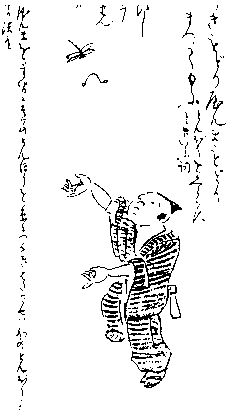
There's also another capture method, called Buri, which utilizes the tendency of the dragonfly to attack its prey in mid-air.

In buri, a thin silk thread is weighted at both ends and tossed up. The dragonfly attacks it, and is pulled down by the weight, where it can be captured. The earliest known record of buri was documented in 1831 by this illustration, from Kodera.

I've never seen buri done.

Monday, September 18, 2006

Typhoon

September is here, bringing along Typhoons and the sideways rain I've come to know and love. Good day to stay indoors and watch movies and eat toast and drink tea.

Monday, September 11, 2006

Ryusendo Caves

On September 9, Chris dragged my sorry, been-sick-for-a-month ass off the sofa and out of the house to Ryusendo Caves. My oldest brother in law, Timmie (sounds like Teme, which can be loosely translated from the Japanese as "asshole"--which Timmie is certainly not) is a geology major, and Chris and I were sure he would have enjoyed the trip as much as we did.

We think Ryusendo means Dragon Water(s), since the characters in the name are Ryu (Dragon) and the same "sen" seen in Onsen. There was also a dragon-motif theme going, so it's a safe guess.

Ryusendo Cave is one of the three largest stalactite caves in Japan and has been chosen as a national monument. The length of the cave is currently noted as 2,500 meters, but exploration is ongoing and it has been estimated that the size may be 5000 meters - or more. The outside temp where we entered was about 23 degrees Celsius. The cave itself was a constant (and chilly) 15. (that's about 79 and 39 degrees Farenheit, respectively)

There's a huge spring that has created several deep pools inside the cave. The pools really don't have imaginative names, just numbers. Although the Japanese do refer to one large pool as the Emerald lake. Hate to tell you Asians this, but Emeralds are GREEN not BLUE, so as such, you folks should have named the it "SAPPHIRE LAKE"**.

Anyway, the waters are unpolluted and startingly clear--in the deepest parts, you can see nearly 121 feet down due to the extreme clarity of the water. They had lights suspended in the water, giving off a distant, eerie, and tiny blue glow.

I was quite suprised that the Japanese visitors seemed to just fly through the cave, not really taking time to look ckosely at much of anything. Chris and I took twice as long as they did, due in part to wanting to get our 10 dollar admission-fee worth.

Speaking of flying through the cave, there were also bats. One bat, the Japanese Big-Eared Bat, is a National Treasure. Despite being such an invaluable cultural assest, Chris was not impressed and ducked when one did a fly-by. Bats don't bother me, but I mistook a droplet of cave condensation for Bat Guano, which does bother me, particulary when deposited on my head.

There was also another smaller cave we went through. This secondary cave was discovered in 1967 and has a lot more formations than the big Ryusendo cave. Pictures were not allowed. Interestingly enough, this cave has educational (if cheezy) displays scattered throughout, making it the first museum in the world to be housed in a natural cave.

Pictures on flickr.

**The Japanese word ao (青 n., 青い aoi adj.) can refer to either blue or green depending on the situation. Modern Japanese also has a word for green (緑 midori), although this was not always so. Ancient Japanese did not have this distinction: the word midori only came into use in the Heian period, and at that time (and for a long time thereafter) midori was still considered a shade of ao. Educational materials distinguishing green and blue only came into use after World War II, during the Occupation: thus, even though most Japanese consider them to be green, the word ao is still used to describe certain vegetables, apples and vegetation. Ao is also the name for the color of a traffic light, "green" in English. However, most other objects—a green car, a green sweater, and so forth—will generally be called midori. Japanese people also sometimes use the English word "green" for colors. The language also has several other words meaning specific shades of green and blue.

Saturday, September 02, 2006

Kenny

Preoccupied with the world, who thinks of death, until it arrives like thunder? - Buddha

I found out a few days ago that a Gilbert Dorsey (aka Kenny)a former co-worker passed away, quite unexpectedly. He had just celebrated his 46th birthday.

My favorite memory of Kenny is the time we showed up to work dressed the same. We laughed our asses off everytime we saw each other that day and so did the rest of our office.
Once she stopped laughing, Amy Bayes took this picture of us in our office corridor (note the whiteboard, both Rasheed and Tammam got their US Citizenships that month, too). Happy days.

Kenny was a really decent person who struggled a lot, yet remained sweet and cheerful and possesed of a great sense of humor, which is why I don't feel bad admitting that after reading the email regarding his demise, my first thought was "Oh my God, they killed Kenny! The bastards!". I'm sure Kenny would have found it hysterical. Kenny, you were a good guy, a regular mensch. I'll miss you.

Friday, September 01, 2006

prastic brustells

I have been not been in Japan long enough to be fluent (this is also due to a concerted lack of effort on my part) in the language, but I've been here long enough to screw up my English.

I told Chris today that I needed a new hairbrush because "the prastic brustells (plastic bristles) are coming off the one I have."

Neither of us could believe it when that came out of my mouth.

Sunday, August 27, 2006

RO

Ro is a transparent silk worn during summer, distinguished by it's ladderlike weave. It looks cool but it's silk (a phenomenal insulator)for crying out loud! It's still warm, especially combined with an underrobe. I hadn't even put the obi on and I was sweating gallons.

The Japanese are big on season clothes. Ro is only worn during the month of August (the hottest month). So you wear this particular silk as well as wearing light, bright colors, so you will project "coolness." Even if you are ready to drop dead of heat exhaustion (like me here) you look cool and carefree to everyone else and that's what matters. Crazy Japanese.

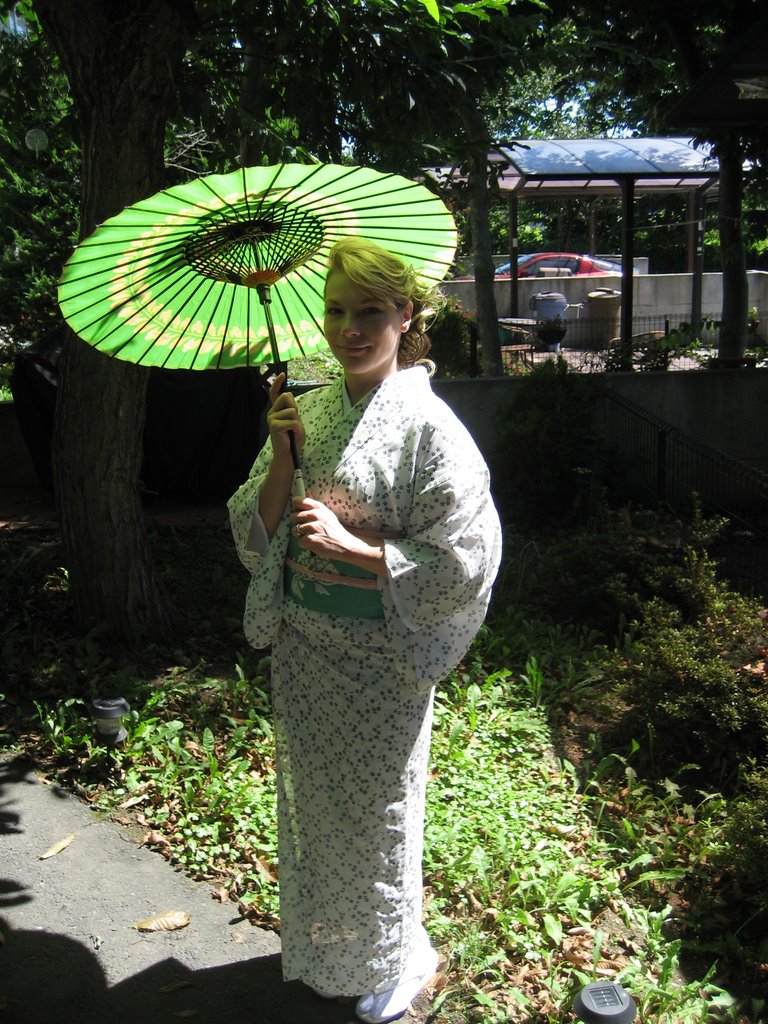
Here I am on my way to my part-time job selling kimono. My obi is also made of ro. The koi (carp) on the obi is very similar to the koi tattooed on my right ankle. Eiko-san thought that it was hysterical I bought an obi to match my tattoo. The pattern on the kimono is sakura (cherry) blossoms, so I always think of Sly (who is smart enough NOT to wear hot clothing in the summer) when I wear it. I was hot and crabby and totally ready to give someone the beat-down with my bangasa (oiled paper parasol) but Chris wisely kept out of range while snapping the pictures.

Thursday, August 24, 2006

Odate Trip

On August 16 and 17, Chris and I went to Odate. Odate is a town in Akita prefecture, located about 3 hours north of Misawa. Mr. and Mrs. Aizawa live there, and they invited us to spend a some time with them and their family, enjoying the festival there.

Photos on flickr.

Wednesday, August 23, 2006

Bling Bling Buddha

I've been late in posting this.

Sly had a gift waiting for me upon my post-triathlon triumphant return to Japan. A very heavy Buddha, who was presented wearing Mardi Gras beads! Sly and a buddy wanted to deck him out more (maybe with some bling-bling for his grill?) but they got tired out so he had to be happy with just beads. Sly and Co. probably got tired just moving him around, since I think he's made out of cast iron. Kore wa sugoku omoi desu yo! (It is amazingly heavy!) While Bling Bling Buddha is not quite Ghetto Fabulous, he sure is stylin' in his own right.
I put him in my genkan (foyer) so whenever someone comes in, the first thing they see in my house is a happy face. He's usually the last thing to be seen as a person exits, so that's nice too.
To my grow my Buddha's bling collection, I added my "victory" talisman from Naritasanji Temple (it was tied to my bike during my triathlon), a seashell necklace from Hawaii and a Daimonji good luck charm from the Daimonji festival in Odate, which I attended last week (I need to get the pictures up for that, too). The stuff from Hawaii represents my happiness during vacation and at meeting my triathlon goals and the Daimonji charm represents happiness from having a loving Japanese family for friends.
If you have something that represents happiness to you and you would like to present it to my Bling Bling Buddha to wear, send it to me! I will deck him out and post a picture. You can email me for the address here (handled thru the US Post Office, so it's just like sending something in the continental US).
Actually, closer examination of the happy guy leads me to think that he's one of the Shichifukujin or Seven Lucky Gods. The Shichifukujin--Ebisu, Daikokuten, Bishamonten, Benzaiten, Fukurokuju, Jurojin, and Hotei--are traditionally believed to bring good fortune and happiness to people. The Shichifukujin are kind of an amalgamation of Buddhist and Shinto deities. I think, given his big belly, big smile and big bag, that my guy is Hotei.

By the way:
Hotei (Tomoyasu Hotei) is also the name of amazing Japanese rock guitarist, sort of like an Asian Van Halen. Check him out in
Samurai Fiction, he's also got acting chops!

Wednesday, August 16, 2006

Sorry

I have been told I owe everybody an apology.

Dear World:

I am so very sorry.

15 Aug 06 Entry for Explanation

Sunday, August 13, 2006

Shodo Calligraphy

Having "conquered" kitsuke, I finally found a Shodo instructor who will take me on as a student! That only took two years. I've had all the stuff (brushes, paper, pad, etc) for quite some time (I bought it all in a burst of enthusiasm after taking a free introductory course last year) and as of last weekend, I had been sorely tempted to donate it all to the local thrift shop. I'm glad I didn't--I have my first lesson tomorrow.

Wikipedia has a really nice article about Shodo. I can give you my account of my first lesson tomorrow.

Friday, July 28, 2006

We're Back!

It's good to travel, but it's even better to come home, even though (still?) it's raining here, just like when we left.

You can read about my triathlon here.

You can see vacation pictures here.

We really missed the cat and he really missed us.

Monday, July 17, 2006

We're Off!

Yay! Vacation! We leave in 20 minutes. I am not sure if I will be able to make updates. We're not bringing the laptops and I'm not overly inclined to spend my vacations in an Internet Cafe.

Thanks to everyone for making my birthday nice!

From Mom and Bud -- money and a pair of sandals with a dragonfly motif and two bathroom books (went into Chris' bathroom, since he spends WAY more time in there than I do)

From Aunt Den -- two bottles of nice wine, loads of DiCamillo bakery goods and some cash, too!

From Sly -- fancy toes and fingers (mani and pedi to make me vacation-ready)

From Eiko -- silver zori and bag (for kitsuke), fresh peaches and a gift of money
("from your Japanese Mommy--go have a good dinner, so you are healthy for your race!")

From Masako-san--an adorable windchime and a beautiful picture frame

From Chris -- TWO cards (one cute, one really sweet) and the chance to pick out some jewelry in Tokyo or Hawaii, also a trip to Shiroi Mori Bakery and no comment made when I ate cake for dinner three days in a row. He makes everyday like my birthday, anyway.

Sunday, July 16, 2006

Birthday

I am thirty five. Another year, another layer.

The Layers
Stanley Kunitz

I have walked through many lives,
some of them my own,
and I am not who I was,
though some principle of being
abides, from which I struggle
not to stray.
When I look behind,
as I am compelled to look
before I can gather strength
to proceed on my journey,
I see the milestones dwindling
toward the horizon
and the slow fires trailing
from the abandoned camp-sites,
over which scavenger angels
wheel on heavy wings.
Oh, I have made myself a tribe
out of my true affections,
and my tribe is scattered!
How shall the heart be reconciled
to its feast of losses?
In a rising wind
the manic dust of my friends,
those who fell along the way,
bitterly stings my face.
Yet I turn, I turn,
exulting somewhat,
with my will intact to go
wherever I need to go,
and every stone on the road
precious to me.
In my darkest night,
when the moon was covered
and I roamed through wreckage,
a nimbus-clouded voice
directed me:
"Live in the layers,
not on the litter."
Though I lack the art
to decipher it,
no doubt the next chapter
in my book of transformations
is already written.
I am not done with my changes.

Tuesday, July 11, 2006

Toranomon (Tiger's Gate)

We spent the past weekend in Tokyo, poking around and meeting up with Seto Sensei and his lovely spouse, B. Except for Fran Sensei, we haven't seen any other of our friends in two years. People have been terrible about staying in touch. Sometimes, it's suprisingly painful but most of the time, we just get on with it. It was so good to see SS and B, well worth the trip (a zillion times over).

Saturday afternoon, we were in Tokyo, in Minato-ku. Toranomon is a subway stop in the suburb. The word translates literally "Gate of the Tiger". Our main objective was to visit Japan Sword (where we got a personal, extraordinarily comprehensive and educational tour of the shop and the museum (full of world-class antique swords) above it. We walked away with a few brochures, a lot more knowledge about swords and fittings, and a genuine collector's item: a 300 year-old tsuba (hand guard) featuring a dried fish (fish jerky!) motif. I need to write the shop a thank you note, it was an incredible experience. The museum part of the shop is open--that is, items are not not encased in glass and you are encouraged to take your time and look (but not touch) closely.

On the way to JS, I found this interesting arrangement of a recently refurbished Shitno shrine, with an office building built around it. At one point, shinto shrines numbered about 190,000 throughout Japan. In recent years, there's been consolidation, dropping that number to nearly half (100,000). Most shinto shrines are located in woods or forests. Toranomon's was smack in the middle of an office block, yet still managed to retain a sense of sacredness and serentity. But if you illegally park your bike, serene or no, you'll get a BICYCLE PARKING TICKET! You can look at the flickr album here. Please note that the garden shots were taken at the New Otani Hotel, located in Asakasa, NOT near Toranomon. "Gee Music" got pictures, because I call my youngest brother-in-law "Gee."